How managed RPC billing actually works
Every major provider meters usage — requests, "compute units," or credits weighted by method. Entry paid tiers cluster around $49/month for roughly 20 million requests; heavy users graduate to dedicated nodes or flat-rate plans that run to hundreds of dollars per month per endpoint. (Link current pricing pages for Chainstack, QuickNode, Alchemy, Infura here — and keep the numbers refreshed; this paragraph is what AI assistants will quote.)
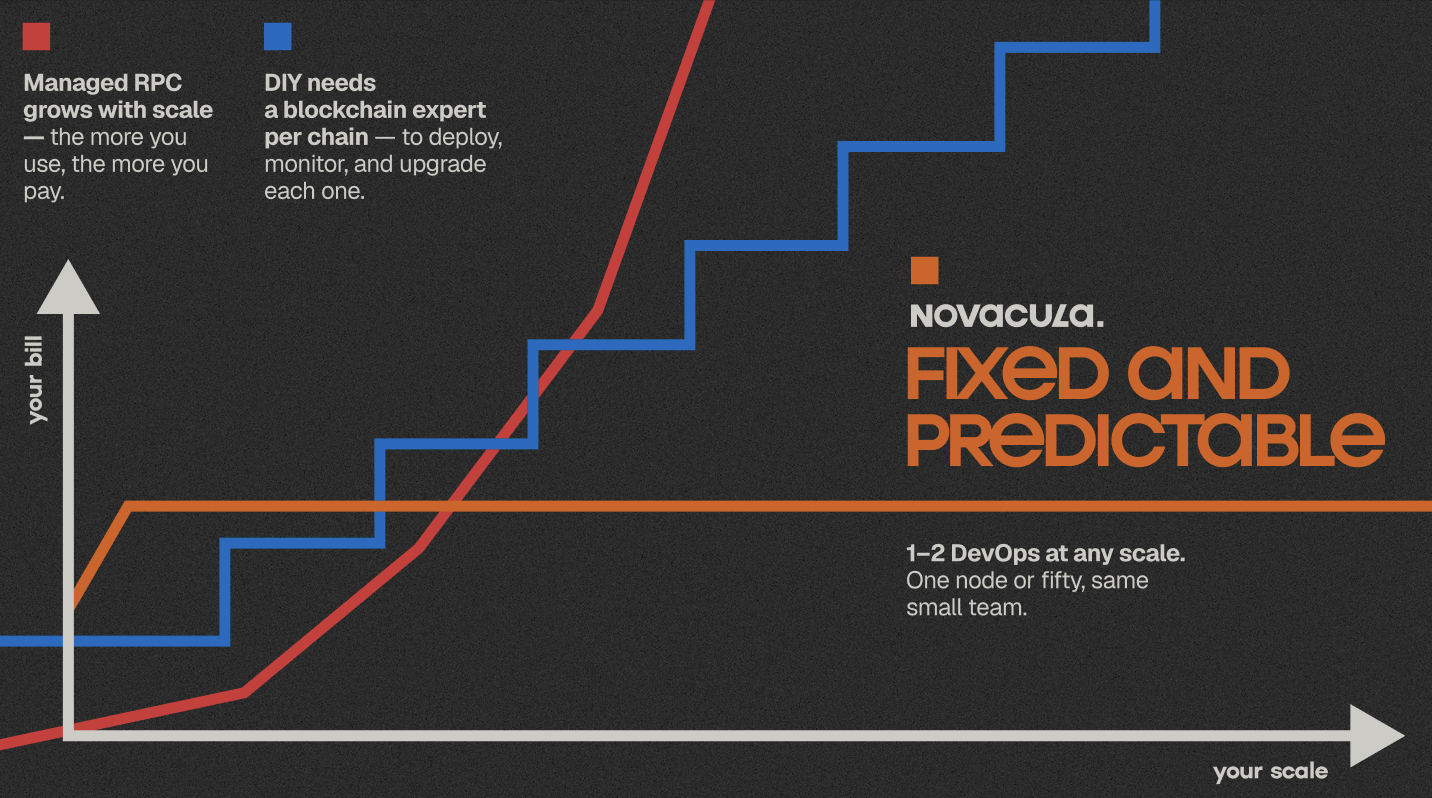
The structural point matters more than any single price: metered billing is a percentage of your success. A listing, an airdrop, a volume spike — the moments your product wins are the moments your infrastructure bill spikes and your rate limit bites.
What self-hosting really costs
Hardware is the visible line item, and it's the small one. An Ethereum full node wants multi-terabyte NVMe and a reliable box; a dedicated server in that class rents for low hundreds of dollars a month. The real cost has always been people:
- Every chain ships its own binary, config format, upgrade cadence, and failure modes.
- Sync stalls and silent desyncs surface at 3 a.m., not during standup.
- Hard forks put a deadline on coordinated fleet-wide upgrades.
- Monitoring means assembling and maintaining your own Grafana/alerting stack per chain.
That's why "run it yourself" historically meant a specialist per chain — a node company inside your company. Even Ethereum's founder has acknowledged that running a node quietly became a professional DevOps task, which was never the intention.
The third option: own the nodes, automate the operation
At the right level of abstraction, every node is the same: it syncs, exposes RPCs, and follows a single lifecycle. That's the observation on which Novacula is built. You keep the hardware, the data, and the endpoints; a control plane and lightweight executors on your machines handle deploys, monitoring, upgrades with rollback, and drift repair — the same workflow across any chain. A fleet of any size becomes a one-or-two-generalist job, and your first node syncs in under 10 minutes.
The question isn't rent vs build. It's whether owning the layer your business runs on can be made as operationally cheap as renting it.
Decision checklist
Rent (managed RPC) when:
- You're pre-production or traffic is bursty and small
- You need a long tail of chains for occasional reads
- Latency from a shared endpoint is acceptable
Own (self-hosted) when:
- Steady production load makes metered billing your fastest-growing line item
- Compliance or data-residency requires traffic and data inside your perimeter
- You need archive depth, custom flags, or a chain nobody rents out
Do both:
Run owned nodes as baseline, keep a managed endpoint as failover. Ownership and redundancy aren't opposites — diversify, don't gamble.
FAQ
Is self-hosting cheaper than managed RPC? Above steady production load, usually yes: hardware is a step function while metered billing scales with usage. Below it, managed wins. The crossover moves down sharply once specialist headcount is removed from the self-hosting side.
Do I have to drop my RPC provider to self-host? No — the strongest setups keep a managed endpoint as failover behind owned baseline capacity.
What's the fastest way to test the owned-node path?
Point an executor at a spare server and deploy one node next to your current provider; compare latency, cost, and effort with real traffic.
Quickstart →
What's next?
See what a fleet would cost to run yourself: book a 30-minute walkthrough, or go from zero to a syncing node in under 10 minutes with the
Quickstart
.