Novacula vs QuickNode

QuickNode provides managed blockchain infrastructure, RPC endpoints, data services and dedicated clusters across many networks. Novacula is built for teams that want to deploy and manage blockchain nodes on infrastructure they control, with direct visibility into node health and operations.

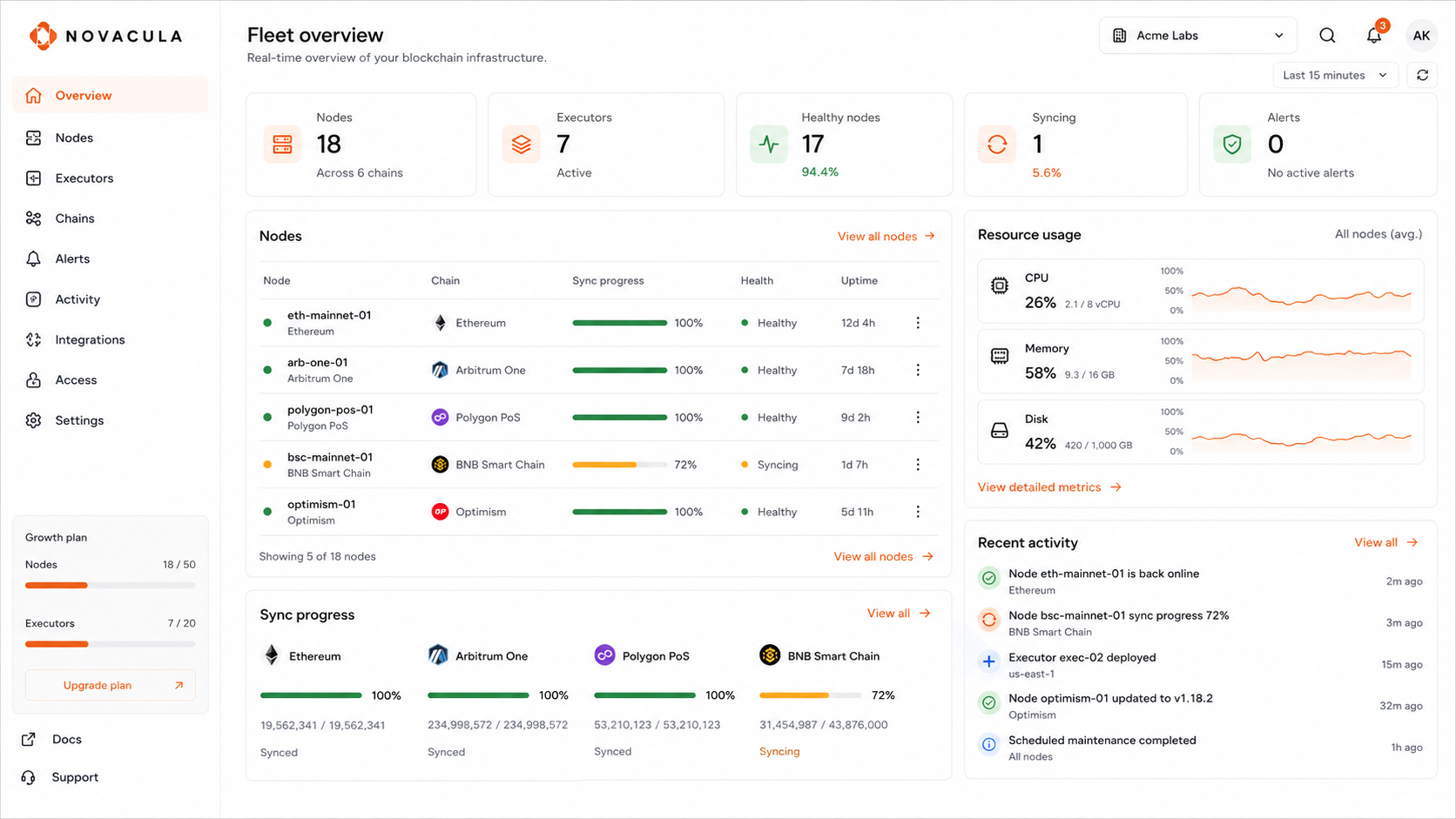
novacula-fleet-overview-dashboard.png

Novacula vs QuickNode: Compare Infrastructure, APIs and Operations

FeatureNovaculaQuickNodeWhat this means for you
Infrastructure modelNodes run on infrastructure your team controls, including supported bare-metal, virtual machine and Kubernetes environments.QuickNode operates the underlying blockchain infrastructure and provides managed endpoints and dedicated infrastructure services.Novacula is built for teams that want direct control over the node environment, while QuickNode abstracts the underlying node infrastructure behind a managed service.
Pricing approachCore Executors are open source. Hub is paid, and Enterprise On-Premise pricing is custom.QuickNode offers credit-based Free Trial, Build, Accelerate, Scale, Business and Enterprise plans, plus Flat Rate RPS pricing for supported endpoints.Novacula combines open-source executors with a paid management Hub, while QuickNode primarily uses API-credit plans and also offers flat-rate endpoint capacity.
API and data modelExpose the chain-native interfaces provided by your nodes, including JSON-RPC, WebSocket or gRPC where supported.QuickNode provides managed RPC, REST, gRPC and WebSocket access where supported, alongside products such as Streams, Webhooks and indexed data services.Novacula keeps infrastructure teams close to the underlying node interfaces, while QuickNode adds a broader managed API and data-service layer for application development.
Deployment modelDeploy and manage nodes on customer-controlled bare metal, virtual machines or Kubernetes through one control plane.Connect applications to QuickNode’s managed RPC infrastructure or dedicated clusters, while QuickNode operates the underlying nodes and handles node upgrades and infrastructure maintenance.Novacula gives infrastructure teams control over where nodes run, while QuickNode provides provider-managed infrastructure that removes most node deployment and maintenance work.
Operational visibilityMonitor node health, synchronization, peers, resource usage, metrics and selected logs from the control plane.QuickNode provides endpoint metrics, usage and billing data, plus request logs and Prometheus-compatible usage metrics for Enterprise customers.Novacula focuses on the health and operation of the underlying nodes, while QuickNode focuses more on visibility into managed endpoints, API usage and request activity.

Infrastructure model

Novacula
Nodes run on infrastructure your team controls, including supported bare-metal, virtual machine and Kubernetes environments.
QuickNode
QuickNode operates the underlying blockchain infrastructure and provides managed endpoints and dedicated infrastructure services.
What this means for you
Novacula is built for teams that want direct control over the node environment, while QuickNode abstracts the underlying node infrastructure behind a managed service.

Pricing approach

Novacula
Core Executors are open source. Hub is paid, and Enterprise On-Premise pricing is custom.
QuickNode
QuickNode offers credit-based Free Trial, Build, Accelerate, Scale, Business and Enterprise plans, plus Flat Rate RPS pricing for supported endpoints.
What this means for you
Novacula combines open-source executors with a paid management Hub, while QuickNode primarily uses API-credit plans and also offers flat-rate endpoint capacity.

API and data model

Novacula
Expose the chain-native interfaces provided by your nodes, including JSON-RPC, WebSocket or gRPC where supported.
QuickNode
QuickNode provides managed RPC, REST, gRPC and WebSocket access where supported, alongside products such as Streams, Webhooks and indexed data services.
What this means for you
Novacula keeps infrastructure teams close to the underlying node interfaces, while QuickNode adds a broader managed API and data-service layer for application development.

Deployment model

Novacula
Deploy and manage nodes on customer-controlled bare metal, virtual machines or Kubernetes through one control plane.
QuickNode
Connect applications to QuickNode’s managed RPC infrastructure or dedicated clusters, while QuickNode operates the underlying nodes and handles node upgrades and infrastructure maintenance.
What this means for you
Novacula gives infrastructure teams control over where nodes run, while QuickNode provides provider-managed infrastructure that removes most node deployment and maintenance work.

Operational visibility

Novacula
Monitor node health, synchronization, peers, resource usage, metrics and selected logs from the control plane.
QuickNode
QuickNode provides endpoint metrics, usage and billing data, plus request logs and Prometheus-compatible usage metrics for Enterprise customers.
What this means for you
Novacula focuses on the health and operation of the underlying nodes, while QuickNode focuses more on visibility into managed endpoints, API usage and request activity.

When Novacula May Be a Better Fit

Control the underlying node environment

Run blockchain nodes on infrastructure your team controls instead of consuming provider-managed endpoints or clusters.

Choose where your nodes run

Deploy on customer-controlled bare metal, virtual machines or Kubernetes based on your infrastructure requirements.

Work with node-level operations

Monitor synchronization, peers, resources, metrics and selected logs directly from the node environment.

Novacula vs QuickNode

Novacula vs QuickNode FAQs

Answers to common questions about how Novacula and QuickNode differ in infrastructure control, APIs, deployment and node operations. Talk to our team.

What is the main difference between Novacula and QuickNode?

Novacula is designed for teams that want to run and manage blockchain nodes on infrastructure they control. QuickNode provides managed blockchain infrastructure, APIs and data services.

Does Novacula replace QuickNode?

Not necessarily. Teams can run Novacula-managed nodes alongside third-party managed RPC services when that architecture fits their requirements.

Who controls the infrastructure with Novacula?

Your team controls the infrastructure where the nodes run, while Novacula centralizes deployment, monitoring and supported lifecycle operations.

How does monitoring differ between Novacula and QuickNode?

Novacula focuses on node health, synchronization, peers, resources, metrics and selected logs. QuickNode provides visibility into managed endpoint usage, request activity, logs and API metrics.

How does QuickNode pricing work?

QuickNode primarily uses plans with included API credits and request-per-second limits. It also offers Flat Rate RPS pricing for supported endpoints and custom Enterprise options.

When may Novacula be a better fit than QuickNode?

Novacula may be a better fit for teams that want direct control over where nodes run and need node-level operational visibility and management.

Take Control of Your Blockchain Infrastructure

Deploy and manage blockchain nodes on infrastructure you control, with node-level monitoring, configuration and operations from one control plane.

Sign up